
What Is an API Compliance Scan?
Application Programming Interfaces (APIs) serve as the primary digital conduits connecting modern web applications, mobile platforms, and microservices architectures. By exposing data endpoints and business logic to internal services and external consumers, APIs handle vast volumes of sensitive financial, healthcare, and personal information. Consequently, an API compliance scan acts as a specialized technical evaluation designed to assess whether these endpoints adhere to security standards and regulatory mandates before deployment or during continuous operation.
Security scanners evaluate API architectures against critical risk models such as the OWASP API Security Top 10. These tools systematically test endpoints for broken object-level authorization (BOLA), broken function-level authorization (BFLA), weak authentication mechanisms, excessive data exposure, unvalidated input injection, and improper security headers or encryption protocols (TLS 1.2/1.3).
From a regulatory standpoint, API scanning provides measurable technical evidence required under major compliance frameworks:
- PCI DSS 4.0: Mandates rigorous security controls, vulnerability scanning, and access authorization checks for APIs processing payment card data.
- HIPAA: Requires strict data confidentiality, access auditing, and transport encryption for endpoints transmitting Protected Health Information (PHI).
- GDPR: Enforces data minimization, authorization controls, and protection against unauthorized exposure of personal data.
- SOC 2 Type II: Demands continuous monitoring, access controls, and vulnerability management across cloud service interfaces.
A fundamental distinction exists between running a technical vulnerability scan and demonstrating formal regulatory compliance. A technical scan identifies security flaws and software vulnerabilities across code endpoints, whereas demonstrating compliance requires manual verification, policy documentation, evidence collection, and validation that technical controls meet explicit statutory requirements.
How Long Does an API Compliance Scan Take?
The duration of an API compliance scan ranges from a few minutes for lightweight endpoint checks to several weeks for comprehensive, audit-ready enterprise compliance evaluations. Because scan execution times depend directly on testing scope and backend response speed, organizations must evaluate duration based on specific scan types and infrastructure scale.
Standard automated scanning platforms provide benchmark execution windows for technical testing:
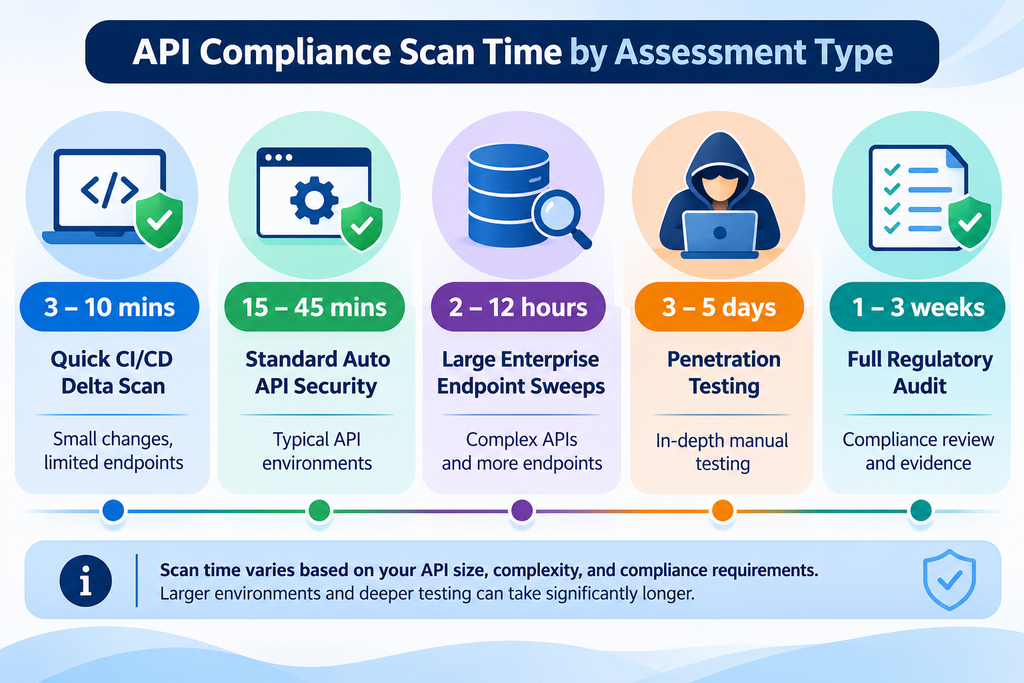
- Quick Automated Scans: Take 3 to 10 minutes when testing a small set of endpoints or scanning delta changes within a continuous integration (CI/CD) pipeline.
- Standard Automated API Scans: Require 15 to 45 minutes for targeted application environments. For instance, Detectify documents typical API scan runtimes of approximately 15 to 20 minutes, whereas Invicti indicates that authenticated web and API scans covering 50 to 200 endpoints often complete within 15 to 45 minutes.
- Large Enterprise Environments: Require 3 to 12 hours (and occasionally multiple days) when scanning complex systems featuring thousands of endpoints, deep parameter fuzzing, restrictive rate limits, or slow database responses.
- Comprehensive Compliance Assessments: Take 1 to 3 weeks to complete when the technical scan is combined with manual penetration testing, false-positive validation, policy documentation reviews, and formal audit evidence compilation.
API Compliance Scan Time by Assessment Type
Different security assessment methodologies alter scan duration significantly based on testing depth, automation levels, and human involvement.
Automated API Vulnerability Scanning
Automated scanning relies on security tools parsing OpenAPI/Swagger specifications or Postman collections to map endpoints automatically. The scanner sends automated HTTP requests containing payloads to identify common vulnerabilities like SQL injection, cross-site scripting (XSS), and header misconfigurations. Because execution relies entirely on automated scripting, these scans complete rapidly, taking between 10 and 30 minutes for average-sized APIs.
Authenticated API Security Testing
Authenticated scans require the testing engine to handle authentication tokens, such as OAuth 2.0 bearer tokens, JSON Web Tokens (JWT), or API keys. The scanner must simulate different user roles (e.g., standard user vs. administrator) to test authorization controls, vertical privilege escalation, and horizontal data leaks (BOLA). Processing authentication state flows, managing token refreshes, and repeating test payloads across multiple privilege levels increases scan duration to 45 minutes to 3 hours.
API Penetration Testing
Manual or hybrid API penetration testing involves certified ethical hackers investigating complex business logic flaws that automated tools miss, such as multi-step workflow bypasses or race conditions. Security engineers analyze custom request sequences, attempt payload bypasses, and manually confirm vulnerabilities. A thorough manual API penetration test typically takes 3 to 5 business days.
Regulatory Compliance Assessment
A full compliance assessment evaluates technical scan results alongside operational policies and regulatory mandates. Auditors review scanning reports, evaluate historical remediation logs, audit access permission matrices, and verify encryption standards across storage and transit layers. Gathering evidence, reviewing findings with compliance officers, and finalizing formal audit reports extends the total timeframe to 2 to 3 weeks.
What Factors Can Make an API Compliance Scan Take Longer?
Several technical variables directly dictate scan duration, turning a routine test into a protracted operation if unmanaged.
- Number of API Endpoints: Scan duration scales linearly with endpoint volume. Testing 15 endpoints with basic parameters requires several hundred requests, whereas scanning 300 endpoints with multiple HTTP methods (GET, POST, PUT, DELETE) and complex JSON payloads generates tens of thousands of requests.
- Authentication and Authorization Complexity: APIs utilizing multi-factor workflows, frequent token expirations, or multi-tenant role matrices require continuous credential negotiation during scans. If a token expires mid-scan, the scanner must re-authenticate, adding overhead.
- API Documentation Quality: Clear OpenAPI 3.0 definitions allow scanners to target valid endpoints, parameters, and data types immediately. Missing parameters, absent schema definitions, or broken request examples force scanners to guess payloads through brute-force discovery, drastically extending scan time.
- Rate Limits and Server Response Times: API gateways enforcing rate limiting (e.g., 100 requests per minute) force security scanners to insert delay throttles between requests to avoid triggering 429 Too Many Requests errors or knocking down the backend server. Additionally, slow database queries lengthen the round-trip time for every security payload.
- Depth of Vulnerability Testing: Basic configuration checks execute quickly. In contrast, deep fuzzing—which injects thousands of mutated payloads into nested JSON parameters to detect blind SQL injection or remote code execution—requires substantially higher request volumes.
- Network Restrictions and WAF Interferences: Web Application Firewalls (WAFs) or Intrusion Prevention Systems (IPS) that block, drop, or challenge scanner IP addresses force security teams to pause, reconfigure allowlists, or re-run dropped request batches.
What Happens During an API Compliance Scan?
Understanding the inner mechanics of an API scan helps administrators track progress accurately during execution.
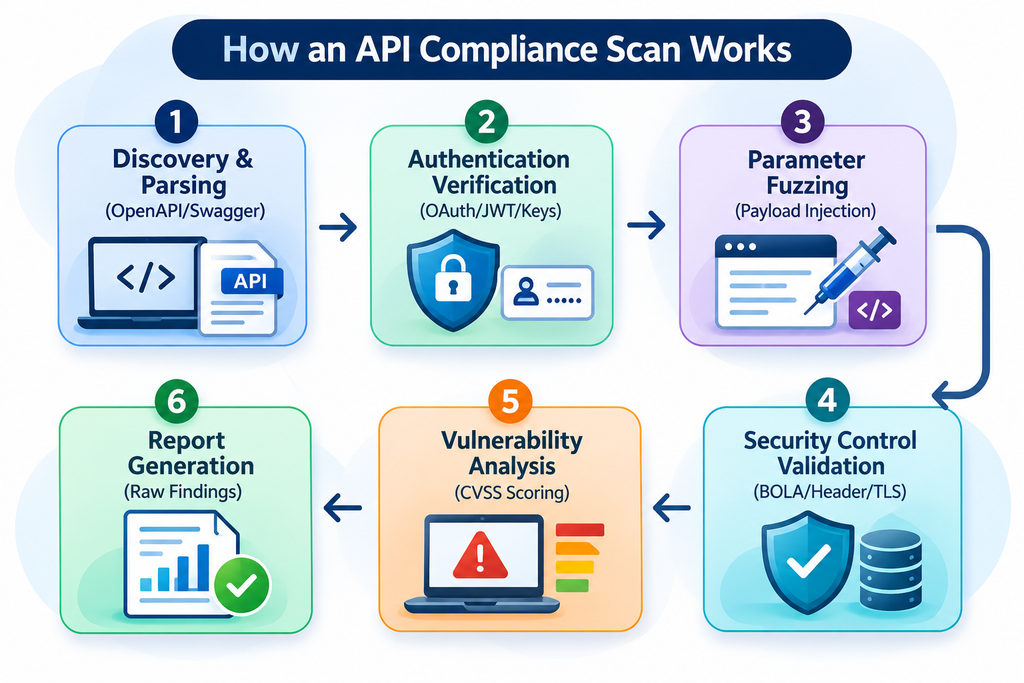
- Discovery and Parsing: The scanning engine imports the API specification (e.g., OpenAPI/Swagger JSON or YAML file) to map out all valid paths, required headers, query parameters, and request body schemas.
- Authentication Verification: The scanner tests administrative credentials, acquires active session tokens or JWTs, and validates that communication with protected endpoints is established.
- Parameter Fuzzing: The tool iterates through endpoints, sending structured HTTP requests containing security payloads to test for injection flaws, input validation errors, and malformed data handling.
- Security Control Validation: The scanner evaluates specific security controls, verifying TLS configurations, inspecting CORS policies, checking security headers, and attempting unauthorized access across role levels.
- Vulnerability Analysis: The engine analyzes returned HTTP status codes, error messages, and response body data to confirm potential vulnerabilities and assign severity scores based on the CVSS framework.
- Report Generation: The platform consolidates findings, removes duplicate alerts, categorizes vulnerabilities by compliance framework metrics, and produces actionable remediation reports.
Why Is My API Compliance Scan Taking So Long?
When an API scan appears stalled or exceeds expected timeframes, technical bottlenecks within the scanner, network, or target server are usually responsible.
- Queue Delays: Enterprise cloud scanning engines often place scan requests in shared job queues. For example, documentation for Google Cloud Web Security Scanner notes that scans may wait in queue for several hours before execution begins during peak load periods.
- Throttling by Rate Limiting: If the API gateway detects a surge in requests, it may enforce rate limits, forcing the scanner to back off and delay subsequent requests.
- Expired Credentials: If a test OAuth token or session key expires mid-scan and the scanner is not configured for automatic re-authentication, the tool will repeatedly retry endpoints or hang on authentication challenges.
- WAF and Firewall Interference: Security appliances may silently drop scanner packets instead of returning explicit error codes. This forces the scanner to wait for full connection timeouts on every request.
- Recursive Endpoint Crawling: If the scanner discovers hypermedia links or dynamic endpoints in JSON responses, it may enter unintended, recursive scanning loops across dynamic resources.
How Long Does It Take to Receive the API Compliance Report?
Completing the technical scan phase is distinct from receiving an audit-ready compliance report. Automated dashboards typically display raw vulnerability findings immediately upon scan completion. However, turning raw telemetry into a verified compliance artifact requires additional processing steps:
- Automated Data Processing: Takes 5 to 15 minutes post-scan for the scanning platform to parse logs, aggregate duplicate issues, and compile initial vulnerability graphs.
- False-Positive Validation: Security analysts spend 2 to 24 hours manually verifying critical and high-severity flags to eliminate false positives before sharing reports with executive stakeholders or external auditors.
- Remediation and Retesting: If scanning uncovers critical vulnerabilities, engineering teams must patch the underlying code and run a verification scan. This remediation cycle typically takes between 2 and 10 business days.
- Final Compliance Sign-Off: Compiling verified technical scans, policy documentation, and attestation statements into a formal regulatory report for PCI DSS, HIPAA, or SOC 2 audits generally requires 3 to 5 business days of administrative review.
How to Reduce API Compliance Scanning Time
Security and DevOps teams can optimize scanning workflows to decrease execution times without compromising security coverage or audit validit
- Maintain Accurate API Documentation: Provide clean, fully defined OpenAPI 3.0+ specifications. Pre-defined parameter formats eliminate the need for scanners to perform time-consuming endpoint discovery and parameter guessing.
- Pre-Configure Authentication Scripts: Supply valid, long-lived API keys or automated token refresh scripts within the scanner configuration to prevent mid-scan authentication failures.
- Prune Scope and Remove Legacy Endpoints: Exclude deprecated, staging-only, or third-party external endpoints from routine scans to ensure resources remain focused strictly on active, in-scope production APIs.
- Allowlist Scanner IPs in Security Controls: Configure WAFs, API gateways, and IPS devices to allowlist designated scanner IP addresses, preventing connection drops and artificial response latency.
- Adjust Rate Limits in Staging Environments: Conduct deep compliance scans within dedicated staging or pre-production environments where rate limits can be safely relaxed or disabled for authorized scanner IPs.
- Integrate Incremental Scanning into CI/CD: Implement continuous, incremental security scans within build pipelines. Scanning small code changes on every pull request takes 2 to 5 minutes, avoiding the need for lengthy, monolithic scans right before compliance deadlines.
Frequently Asked Questions About API Compliance Scanning
How long does a basic API security scan take?
A basic automated scan covering a small API with 10 to 30 endpoints typically takes 15 to 30 minutes. Lightweight checks integrated into continuous integration pipelines can finish in under 10 minutes.
Can an API compliance scan take several days?
Yes. Large enterprise environments featuring hundreds of endpoints, complex authentication schemes, restrictive rate limits, and deep payload fuzzing can take 24 to 48 hours to scan completely. Furthermore, full regulatory audits that include manual penetration testing and compliance evidence validation can take 1 to 3 weeks.
Does authenticated API scanning take longer than unauthenticated scanning?
Yes. Authenticated scanning takes significantly longer because the engine must manage session states, process token refreshes, and iterate through multiple user role permissions to test for authorization flaws like BOLA and privilege escalation.
How often should APIs undergo compliance scanning?
Industry standards recommend running automated API security scans continuously within the CI/CD pipeline or at least weekly. Comprehensive compliance scanning and manual penetration testing should occur quarterly or after any major API architectural change, as mandated by frameworks such as PCI DSS.
Does a completed API scan mean the API is compliant?
No. A clean technical scan confirms that no automated vulnerabilities were detected during that execution. Achieving true regulatory compliance also requires meeting administrative policy mandates, maintaining access logging, establishing incident response procedures, and passing formal audit reviews.
Why is my API scan showing no results or zero endpoints?
Zero results usually indicate an initial configuration error, such as an invalid or malformed OpenAPI specification file, unhandled authentication failures, or a WAF blocking the scanner’s IP address at the perimeter.