
A civil lawsuit is a formal mechanism to resolve private disputes and seek remedies like financial compensation, property recovery, or specific court orders. Unlike criminal cases, which are prosecuted by the government to punish offenses, civil actions are brought by private individuals or entities to protect their legal rights.
The primary objective of a civil claim is restoration, meaning the court attempts to put the injured party back into the position they would have been in if the harm had never occurred.
Filing a lawsuit is a technical, highly regulated process. A single procedural misstep early on, such as choosing the wrong court or missing a filing deadline, can derail your case before a judge ever reviews the actual merits.
This guide breaks down the essential legal steps, rules of jurisdiction, and evidence requirements you must navigate to bring a civil action to a successful resolution.
What Is a Civil Lawsuit?
A civil lawsuit is an adversarial legal proceeding where a filing party, the plaintiff, seeks a remedy against an opposing party, the defendant. These cases are governed by strict procedural rules, specifically the Federal Rules of Civil Procedure (FRCP) in federal courts, or individual state statutory codes in local courts.
Civil courts handle a wide range of everyday business and personal disputes. Common grounds for a civil action include:
- Breach of business contract
- Unpaid debts
- Property boundary disputes
- Personal injury claims
- Employment or wage disputes
- Consumer fraud
- Partnership disagreements
- Landlord-tenant conflicts
- Defamation
When a plaintiff wins a case, the judge or jury grants specific forms of relief depending on the facts.
The court typically awards a few primary types of civil remedies:
- Compensatory Damages: Money meant to cover direct financial losses, medical bills, or lost profits.
- Punitive Damages: Extra financial penalties meant to punish intentional or reckless behavior.
- Injunctive Relief: A direct court order forcing the defendant to take action or immediately stop a harmful activity.
- Specific Performance: A ruling forcing a party to fulfill a unique contractual obligation, such as selling a specific piece of real estate.
Step 1: Determine Whether You Have a Valid Legal Claim
You cannot sue someone simply because they treated you unfairly or caused an argument. To file a successful lawsuit, you must prove a recognized cause of action, which means your situation must meet every single legal requirement of a specific law.
Different claims have distinct legal building blocks that you must satisfy.
Breach of Contract Elements
To win a basic contract case, you must prove three things. First, a valid, binding contract existed between you and the defendant. Second, the defendant failed to fulfill their specific obligations without a legitimate excuse. Third, this exact failure directly caused your documented financial losses.
Negligence and Tort Elements
For personal injury or property damage claims, you must establish four clear points. You must prove the defendant owed you a specific duty of care under the circumstances, such as a driver following traffic safety laws.
You must show they explicitly breached that duty. Finally, you must prove that this breach was the direct cause of the incident and that you suffered actual, measurable damages as a result.
Fraud Elements
Fraud claims carry a very high burden of proof. You must show the defendant knowingly made a false statement about a material fact with the explicit intent to deceive you. You must also prove that you reasonably relied on that false information, and that this reliance directly caused your financial ruin.
Before spending time and money on a lawsuit, evaluate your case by answering these structural questions:
- What specific statute or common law rule did the defendant violate?
- Do you have concrete evidence to prove every individual element of that violation?
- Can you clearly calculate your financial damages?
- Is your evidence strong enough to meet the civil burden of proof, known as a preponderance of the evidence?
Step 2: Make Sure You Are Filing Before the Deadline
Every civil claim is attached to a strict expiration date known as the statute of limitations. If you fail to file your case before this window closes, the defendant can have your lawsuit thrown out immediately, no matter how much evidence you have.
These deadlines change dramatically depending on your state and the exact type of claim you are bringing.
The legal system applies different filing windows based on the nature of the dispute:
- Personal Injury: Usually ranges from one to six years from the date of the accident.
- Breach of Contract: Typically spans from three to ten years for written agreements.
- Property Damage: Generally restricted to a window of two to six years.
- Fraud: Often two to six years, frequently starting only when you actually discover the deception.
Step 3: Gather Evidence Before Filing
Civil lawsuits are won with physical and digital proof, not verbal accusations. You must actively collect and secure all relevant documents before you file your paperwork, ensuring key files are not accidentally lost or intentionally destroyed by the other side.
Organize your initial evidence into these clear categories:
- Signed contracts, invoices, receipts, and bank wire records.
- Complete email threads, text messages, and direct messages with clear timestamps.
- High-resolution photographs or video footage of property damage or the incident scene.
- Full contact details and signed written statements from independent eyewitnesses.
Step 4: Determine the Correct Court
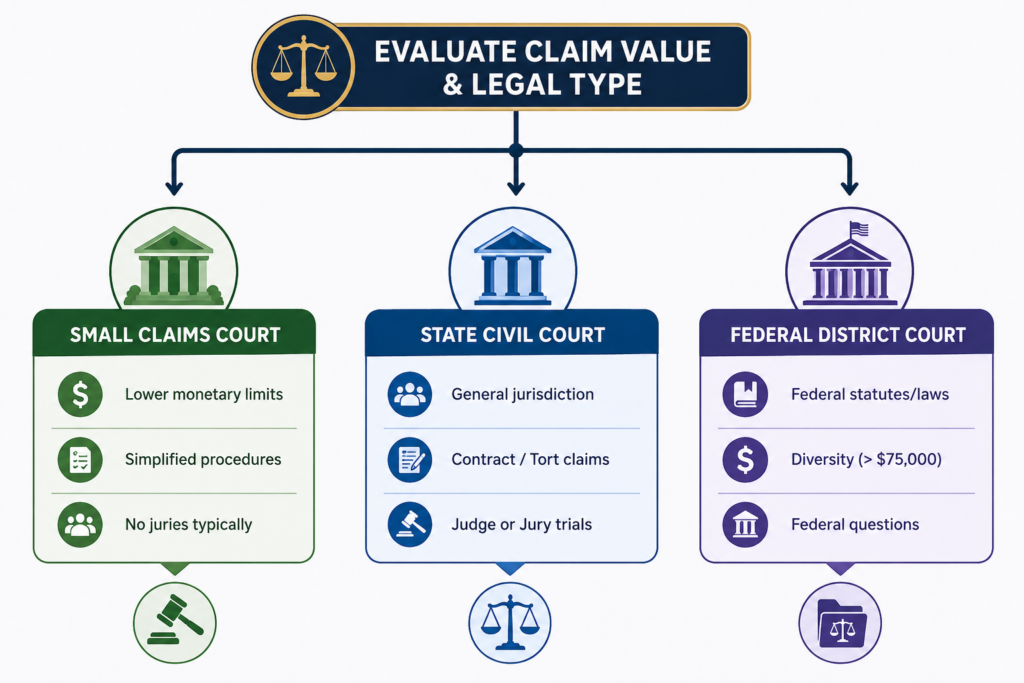
You must file your case in a courthouse that has the legal authority to make a ruling. This means the court must have subject-matter jurisdiction over your specific type of claim, and personal jurisdiction over the defendant based on where they live or do business.
Small Claims Court
This division is built for low-value financial disputes and uses simple, informal rules. Most states cap small claims cases at thresholds ranging from $2,500 to $25,000. These courts move quickly, do not allow long discovery phases, and sometimes ban lawyers from the courtroom entirely.
State Civil Court
State courts handle the vast majority of standard business disputes, personal injury claims, and real estate lawsuits. These dockets are usually split into limited civil and unlimited civil tiers based on the total financial value of the case, using a standard threshold like $25,000 to separate them.
Federal Court
The federal system is highly restrictive. To get into federal court, your case must involve a federal question, meaning it is built on federal laws or the U.S. Constitution.
Alternatively, you can qualify through diversity of citizenship, which requires the plaintiff and defendant to live in completely different states, and the financial amount at stake to exceed the mandatory statutory minimum of $75,000.
Step 5: Identify the Correct Defendant
You must pinpoint the exact legal identity of the person or entity responsible for your damages. Suing an incorrect or informal name will cause your case to stall or face immediate dismissal.
Verify your target using official state business registries before filling out paperwork:
- Individuals: Use their full legal name, avoiding nicknames or abbreviations.
- Corporations and LLCs: Search state databases to find the exact registered business name, such as Apex Holdings, LLC, rather than a casual brand name.
- Government Agencies: Lawsuits against cities, states, or federal departments require naming the specific agency and are subject to strict notice rules under sovereign immunity laws.
Step 6: Draft the Complaint
The Complaint is the foundational document that officially opens a lawsuit. It lays out your factual timeline, explains the legal reasons why the defendant is liable, and states exactly what you want the court to order.
A standard civil complaint must contain five core sections:
- The Caption: The block at the top of the first page listing the court name, the parties, and the case number.
- Jurisdiction: A clear explanation of why this specific court has the legal right to hear your case.
- Facts: A numbered, step-by-step chronological list detailing exactly what happened.
- Causes of Action: The specific laws the defendant broke based on those numbered facts.
- Prayer for Relief: The final demand line telling the judge exactly how much money or what specific orders you are requesting.
Step 7: File the Lawsuit With the Court
Once your complaint is finalized and signed, you must submit it to the court clerk. Most modern court systems use mandatory online filing networks, such as CM/ECF for federal cases or state e-filing portals.
You must pay a mandatory court entry fee when submitting a new case.
Filing fees change depending on the type of court you use:
- Small claims court fees are low, usually between $30 and $100.
- Standard state civil courts typically charge between $150 and $450.
- Federal district courts charge a uniform nationwide filing fee of $405.
If you are facing severe financial hardship, you can submit an In Forma Pauperis application alongside your complaint. This form requires you to disclose your income and assets under oath. If the judge approves it, the court will completely waive your filing fees.
Step 8: Serve the Defendant Properly
Filing your paperwork does not mean the case has started. Under constitutional due process rules, a defendant has an absolute right to receive formal notice of a lawsuit so they have a fair opportunity to defend themselves. Delivering these files is called service of process.
You must deliver two specific documents: the court-issued Summons and a copy of your filed Complaint.
You cannot hand these papers to the defendant yourself. You must use an independent third party to execute service:
- Hiring a professional, licensed private process server to hand-deliver the papers directly.
- Paying the local county sheriff’s department civil division to serve the documents.
- Sending the papers via certified mail, though this option is strictly limited or banned for initial notice in many states.
Once delivery is complete, the server must sign a notarized Proof of Service form, which you must file with the court clerk immediately to prove the defendant was officially notified.
Step 9: Wait for the Defendant’s Response
Once served, the defendant has a strict statutory window to submit an official response to the court, which usually ranges from 20 to 30 days depending on the jurisdiction.
The defendant’s legal team will typically respond in one of four ways:
- An Answer: A formal document where they admit or deny each individual paragraph of your complaint.
- A Motion to Dismiss: A request asking the judge to throw out the case due to a fatal flaw, such as lack of jurisdiction or a expired statute of limitations.
- Counterclaims: Filing a reciprocal lawsuit against you within the same case file, claiming you actually owe them money.
- Silence: Ignoring the summons completely and failing to file any paperwork before the deadline passes.
Step 10: Request Default Judgment if No Response Is Filed
If the defendant misses their filing deadline or completely ignores the summons, they forfeit their right to fight the case. This allows you to apply for a default judgment to win the lawsuit automatically.
Winning by default requires completing a specific legal process:
- You ask the court clerk to log an official Entry of Default on the docket, proving proper service was executed and the deadline passed.
- You submit a formal motion to the judge requesting a final judgment, attaching all receipts, bills, and contracts to prove your exact losses.
- For complex calculations, you attend a brief prove-up hearing where you present your damage calculations to the judge under oath.
Step 11: Enter the Discovery Phase
If the defendant files an answer and the case stays alive, the lawsuit enters the discovery phase. This is a formal, court-ordered evidence exchange that often lasts for months and makes up the bulk of the litigation timeline.
Attorneys use four primary tools during discovery to gather information:
- Interrogatories: Written questions that the opposing party must answer under oath within 30 days.
- Requests for Production: Legal demands forcing the other side to turn over physical documents, internal emails, and financial logs.
- Requests for Admission: A list of basic statements the opposition must officially admit or deny to narrow down what actually needs to be argued at trial.
- Depositions: Live, under-oath interviews of witnesses and parties recorded by a court reporter. These transcripts can be used later at trial to expose a witness who changes their story.
Step 12: Participate in Settlement Discussions
Litigation is incredibly expensive and unpredictable. Because of these financial strains, statistics from the Federal Judicial Center show that more than 90% of all civil cases filed in the U.S. settle out of court long before a trial ever begins.
Disputes are commonly settled through three distinct methods:
- Direct settlement letters and compromise phone calls between the opposing attorneys.
- Formal mediation, where both sides meet with a neutral third-party mediator to negotiate a voluntary compromise.
- Court-ordered settlement conferences handled inside the courthouse by a magistrate judge.
Step 13: Prepare for Trial
If settlement talks fail, your legal team must pivot into intensive trial preparation. This phase involves turning your raw discovery data into a highly organized, clear presentation for the courtroom.
Pre-trial preparation requires executing a few critical steps:
- Filing motions in limine to ask the judge to block the other side from using irrelevant or unfair evidence.
- Assembling, labeling, and organizing all physical documents and digital files into formal numbered trial exhibits.
- Subpoenaing key witnesses to guarantee their appearance and practicing direct examinations.
- Writing a comprehensive trial brief for the judge that highlights the specific laws and evidence that prove your case.
Step 14: Attend Trial
The trial is the formal climax of your lawsuit. It can run as a bench trial, where a single judge hears the case and makes the decision, or a jury trial, where a panel of local citizens decides the outcome.
A standard civil trial follows a strict chronological order:
- Both legal teams question a pool of citizens to select a fair, unbiased panel.
- Each attorney presents a high-level summary of the evidence they plan to show.
- You call your witnesses to the stand for direct examination, and the defense challenges them through cross-examination.
- The defense presents their own evidence and witnesses, and your attorney cross-examines them.
- Each side delivers a final summary argument to pull the evidence together.
- The judge or jury deliberates, applies the law, and issues a final verdict on liability and damages.
Step 15: Obtain a Judgment
If you win at trial, the judge’s verdict is converted into an official, signed court order known as a Judgment. This document is logged into the public record by the court clerk, creating a permanent, binding legal debt.
The final judgment breaks down your exact remedy. It locks in your baseline financial compensation, adds any statutory interest that accumulates on the unpaid balance, and orders the defendant to pay your basic court costs.
However, a judgment is just a piece of paper. The court is completely passive and will not collect the money for you; you must take separate steps to get paid.
Step 16: Collect the Judgment
If a defeated defendant refuses to pay the judgment voluntarily, you must use state-sanctioned enforcement tools to forcefully seize their assets to satisfy the debt.
You must apply for additional court writs to target specific assets:
- Wage Garnishment: An order sent to the defendant’s employer forcing them to automatically dock their weekly paycheck (typically capped at 25% under federal law) and send those funds to you.
- Bank Levies: A direct order delivered to the defendant’s bank forcing them to freeze their accounts and transfer the funds to a county sheriff to clear your debt.
- Property Liens: Recording your judgment with the county recorder to place a legal hold on the title of the defendant’s real estate, preventing them from selling or refinancing without paying you first.
- Asset Seizure: Securing a writ of execution that allows a county sheriff to physically seize the defendant’s corporate vehicles, equipment, or business inventory and sell them at a public auction to cover the judgment.
Do You Need a Lawyer?
You have a constitutional right to represent yourself pro se in any American court. If your dispute is straightforward, involves minimal financial risk, and fits neatly inside small claims court boundaries, handling the case on your own is often your smartest option.
However, skipping professional legal counsel in high-stakes or complex matters is an immense operational risk.
You should always retain an experienced civil litigator under specific conditions:
- The financial damages involve large corporate assets or cross state lines.
- The case hinges on complex copyright, trademark, or patent laws.
- The defendant has hired an aggressive, experienced corporate defense law firm.
- You need to hire professional engineers, doctors, or forensic accountants to act as expert witnesses to prove your damages.
- Your case must be filed in the federal court system, which enforces rigid procedural rules and does not tolerate mistakes from self-represented plaintiffs.
Frequently Asked Questions
How much does it cost to open a civil lawsuit?
Filing fees vary depending on the court. Small claims courts cost between $30 and $100, general state courts run from $150 to $450, and federal district courts charge a flat $405. This baseline does not include process server delivery fees, court reporter costs for depositions, or hourly attorney fees, which can drive total costs into thousands of dollars for a contested case.
Can I file a lawsuit without a lawyer?
Yes. You can represent yourself pro se in almost any civil court. However, you will be held to the exact same standards as a licensed attorney. You must follow all local rules of evidence and civil procedure; judges will not overlook technical mistakes or missed deadlines just because you do not have a legal background.
How long does a civil case take from start to finish?
Uncontested cases or small claims matters are usually resolved within two to six months. However, a high-value civil lawsuit involving deep discovery, extensive pre-trial motions, and a full courtroom trial routinely takes anywhere from one to three years to reach a final judgment.
What happens if the defendant completely ignores my lawsuit?
If the defendant fails to file an official response within their statutory window (typically 20 to 30 days), they go into default. You can immediately ask the court clerk to enter a default on the docket and present your evidence to a judge to secure a final default judgment, winning the case without ever going to trial.
Can I sue a person or business located in a different state?
Yes, but your chosen courthouse must have proper personal jurisdiction over them. Under state long-arm statutes, you can generally sue an out-of-state defendant if the underlying contract was signed in your state, if the accident occurred within your borders, or if the business conducts regular operations in your state.
What separates small claims court from regular civil court?
Small claims courts handle low-value disputes using fast, informal procedures with relaxed rules of evidence, and they rarely use juries or allow lawyers. Regular civil courts handle unlimited financial claims but require strict adherence to complex rules of evidence, lengthy discovery timelines, and formal trials.
Will my case actually end up going to a trial?
Probably not. National data shows that more than 90% of all civil lawsuits filed in the United States end up settling out of court. Judges use mandatory mediation sessions and pre-trial conferences to force both sides to find a middle ground, helping everyone avoid the immense costs and risks of a trial.
What if I win the lawsuit but the defendant still refuses to pay?
A court judgment does not automatically force money out of a defendant’s hands. If they refuse to clear the debt voluntarily, you must use post-judgment enforcement tools under state law. This requires you to secure additional writs to execute wage garnishments, place levies on their bank accounts, or record liens against their real estate holdings.